James Mortimer
The Hound of the BaskervillesJames Mortimer is a country doctor whose medical learning, antiquarian interest, and responsibility to the Baskerville family bring the case of the hound to Sherlock Holmes. A friend and former medical attendant to Sir Charles Baskerville, he entrusts Holmes with the family’s old manuscript and asks for guidance about the new heir. His role is that of a conscientious intermediary: he carries evidence from the family and the county, while his own scientific enthusiasms shape how he interprets it.
Identity and Scientific Profile
The Medical Directory identifies Mortimer as a medical practitioner established at Grimpen on Dartmoor, Devon, and records his qualifications from 1882. He had served as house-surgeon at Charing Cross Hospital from 1882 to 1884, won the Jackson Prize for Comparative Pathology, and published work on atavism and progress. He was also a corresponding member of the Swedish Pathological Society and medical officer for the parishes of Grimpen, Thorsley, and High Barrow. This record gives his country practice a substantial professional and scholarly background; he is not merely a local informant, but a doctor with a sustained interest in scientific classification and inherited traits.
That interest is immediately visible in his approach to Sherlock Holmes. Mortimer admires Holmes’s skull and asks to feel along its parietal fissure, imagining that a cast would suit an anthropological museum. His enthusiasm is so absorbing that Holmes recognizes in it a fellow specialist’s devotion to a subject. Mortimer’s own body is described as tall and thin, with a long, beak-like nose, close-set gray eyes behind gold-rimmed glasses, a bowed back, and a forward-thrust head. His professional clothes are worn and untidy; his long, restless fingers make cigarettes with unexpected dexterity. These details present a distinctive figure whose manner combines benevolence, absent-mindedness, and intense intellectual curiosity.
The Manuscript and Sir Charles Baskerville
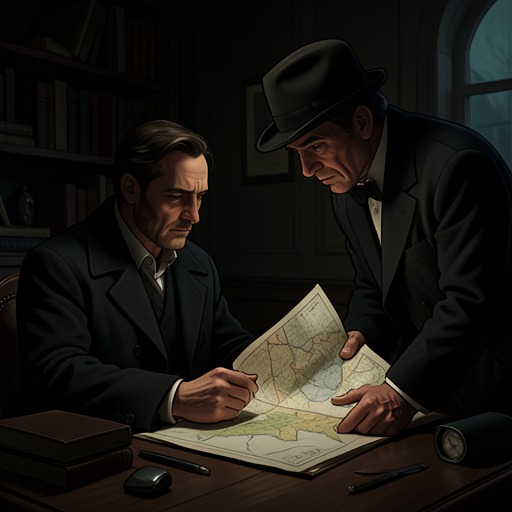
Mortimer arrives at Baker Street to recover a walking stick left behind on an earlier visit, then explains that he has a manuscript in his pocket. The document is dated 1742 and had been placed in his care by Sir Charles Baskerville, whom Mortimer describes as both his personal friend and his medical patient. Sir Charles, he says, was practical and strong-minded, yet had taken the family paper seriously and seemed prepared for the kind of end that eventually overtook him.
The manuscript traces the family legend to Hugo Baskerville, a cruel landowner in the time of the Great Rebellion. It recounts the abduction of a young woman, her flight across the moor, and the deaths of both her and Hugo; a monstrous hound is said to have killed Hugo. The writer presents the tale as inherited family history and couples it with a warning against crossing the moor at night. Mortimer reads this account aloud to Sherlock Holmes and Dr. Watson, making him the first conduit through whom the ancestral story becomes part of the present investigation. Its conclusion also insists on caution about the future, so the manuscript functions both as a record of supposed origins and as advice to later generations.
Mortimer supplements the old family paper with a more recent source: a report from the Devon County Chronicle dated May 14, describing the circumstances surrounding Sir Charles’s death. The shift from manuscript to newspaper moves the inquiry from inherited legend toward a documented modern death. By bringing both texts, Mortimer gives Sherlock Holmes materials of different kinds to compare rather than asking him to accept the family story on its own.
The Heir and the Moor’s Reputation
Mortimer’s immediate concern is what should be done about Sir Henry Baskerville, who is due to arrive at Waterloo Station in an hour and a quarter. He identifies himself not only as a doctor but as a trustee and executor of Sir Charles’s will. After the death, the trustees had searched for the heir and found him farming in Canada; Mortimer describes the reports of his character as favorable. His question to Sherlock Holmes is therefore practical and urgent: the inheritance has a living successor, and Mortimer must advise what course to take before that successor enters the family estate.
The urgency is sharpened by Mortimer’s report of sightings on the moor. Since the tragedy, he says, several people have described a huge, luminous, spectral creature resembling the legendary hound. He has questioned three witnesses—a countryman, a farrier, and a moorland farmer—and stresses that their accounts agree. The reports have produced widespread fear, to the point that crossing the moor at night requires unusual courage. Mortimer frames the sightings as difficult to reconcile with the ordinary order of nature, but the evidence he offers is testimony, not a demonstrated supernatural explanation.
His attitude toward the legend remains complex. When the hound is discussed in the presence of Sir Henry, Mortimer remarks on the peasants’ credulity, yet Dr. Watson senses from his expression that Mortimer himself takes the matter seriously. He also believes that the story strongly affected Sir Charles and may have contributed to his death. Mortimer thus occupies the uncertain ground between professional skepticism and local apprehension: he reports what witnesses say, recognizes the legend’s psychological force, and seeks counsel rather than claiming to have resolved the mystery.
Inheritance, Ancestry, and the Case’s Aftermath
Mortimer’s scientific interests extend to the interpretation of heads and ancestry. During the journey with Sir Henry, he characterizes the heir’s head as Celtic and associates it with enthusiasm and attachment; he likewise describes Sir Charles’s head through a mixture of Gaelic and Iberian traits. These observations show how readily Mortimer applies the period’s physical classifications to personality and descent. They belong to his way of thinking, not to proof that cranial shape establishes character or ancestry.
Later, Sherlock Holmes recognizes a resemblance between the portrait of Hugo Baskerville and the man behind the crimes, treating the likeness as a clue to concealed descent and designs on the succession. In his final account, Holmes identifies that man as a descendant of the Baskerville line. This retrospective discovery confirms the central importance of Mortimer’s original materials: the manuscript had preserved the family’s story, while the modern danger arose from an actual inheritance claim concealed behind another identity.
The case also leaves Mortimer with a personal loss. At the abandoned mine used to conceal the hound, Sherlock Holmes identifies a skeleton with brown hair as Mortimer’s curly-haired spaniel and concludes that Mortimer will never see his pet again. The hound that had seemed to confirm a supernatural family curse was a concealed animal used to produce terror; its lair and the paste used to make it luminous expose the practical machinery behind the apparition. Mortimer’s place in the story consequently joins the intimate and the evidentiary: he brings the inherited warning and the danger to the heir into the investigation, while the final explanation returns the mystery to the cost borne by an individual whose pet became part of the criminal scheme.